

Most of us came into this industry not knowing that we're going to deal with keywords and online rankings, and none of us predicted we're going to battle AI algorithms too. For such a long time, the idea was basically this: win Google, win visibility. However, these days are gone.
Now it's generative tools that decide which voices and stories are trustworthy enough to be cited, rephrased and used all the way at the top of search engine results. This resets how authority is built, and who gets to call the shots.
Try Prowly's media monitoring free for 7 days
Start tracking your brand and keywords for free (no credit card required) in Prowly.
- Comprehensive monitoring: Track the web, social media, print, and broadcast mentions
- Transparent pricing: Plans start at $258/month
- All-in-one platform: Get everything you need in one tool for PR, incl. media database, outreach, reporting, and more
Google is no longer the only gatekeeper
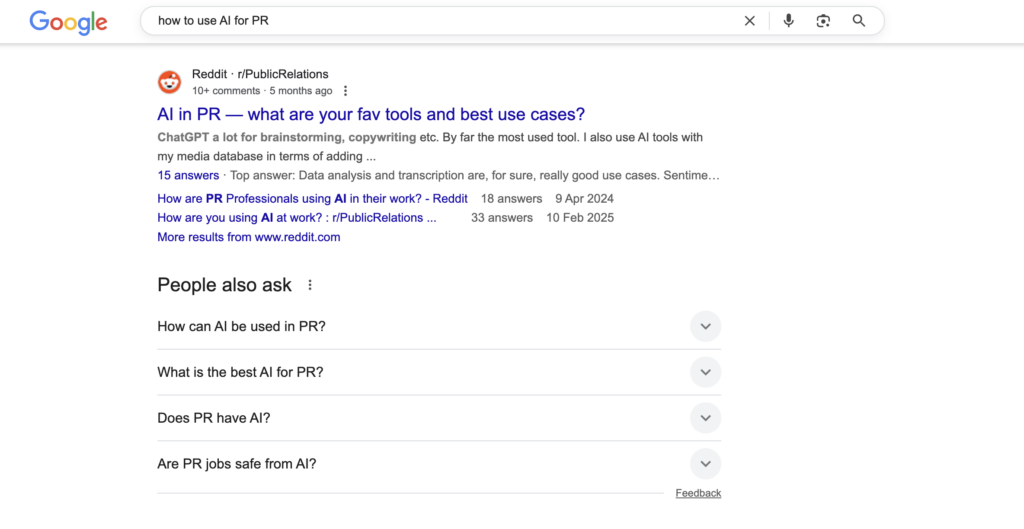
For nearly twenty years Google was the single, most important place for digital visibility. PR campaigns were mainly built around what keywords their target audiences frequented, and what gave the possibility to climb in search rankings. PR goals included keyword optimization, securing backlinks, and a strong hope for your press release or media coverage to end up high in SERPs.
Today, this is all starting to look entirely different, not only for PR professionals and the entire public relations industry, but for everyone who produces content.
AI powered anything changes the rules
While Google still continues to hold nearly 90% of the market share in search, traditional links are no longer what users see first for many queries. Instead, AI Overviews blend authoritative text with a set of citations into machine-generated citations. These are even pushed above top media outlets and organic results.
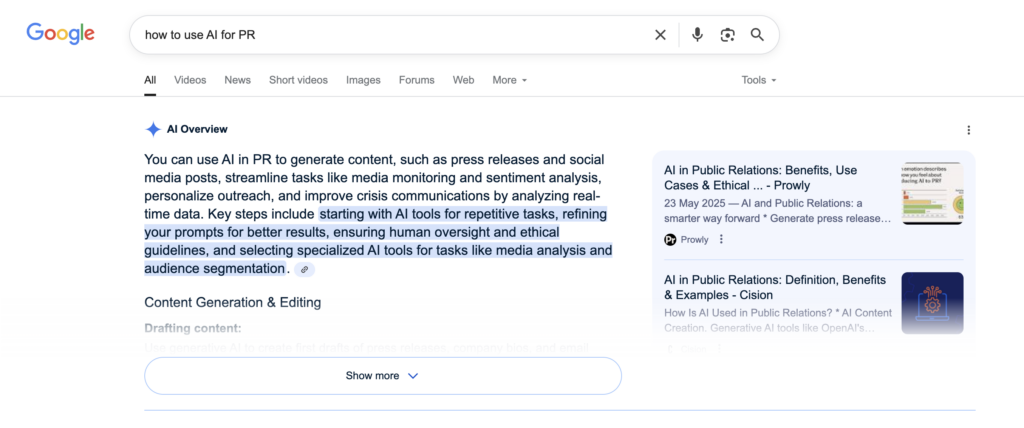
These AI algorithms change the way people consume information about brands. While solid social media posts and content created by PR professionals play a role in brand's visibility, they're competing with AI.
What generative AI search really does
In that case, what makes generative search different at all? Well, it doesn't merely just list sources, it repackages the entire knowledge in an easy-to-digest form.
Google's AI Overviews generate short, mostly authoritative answers and places them at the top of the SERP. Then, beneath it, you're getting clickable citations for added credibility. The catch? Only a handful of sources are actually making the cut (we'll discuss how to 'make the cut' later).
On the other hand, ChatGPT and LLMs synthesize answers from a mix of training data and the latest sources they can pull. When they cite sources, they're usually choosing clearly structured, trustworthy, and authoritative publications or pieces of information (unless they're hallucinating, but that's another story).
Therefore traditional SEO signals like keywords, their placement, backlink volume, and metadata don't directly control whether or not your content shows up in these summaries anymore. Instead, AI-generated summaries prioritize information that looks like a reliable source:
- Insights, citations, and quotes from known, named experts
- Facts and numbers that are easy to verify
- Clear and structured formatting
- Language without "fluffy" phrases
- Coverage from established, top outlets
Sounds like a nightmare? Not exactly. Because what AI-generated summaries are based on, is the exact DNA of great public relations.
PR as the source of record in AI
This is where public relations really, really shines. The qualities AI tools favor are exactly the same ones we've been obsessing over in PR for decades. Here are the 3 key ones to keep in mind:
- Authority: we're already putting a lot of consideration into our press releases to make sure that they're backed up by thought leadership from subject-matter experts, and trying hard to place them in reputable outlets. AI search results trust these voices.
- Structure: we know how to format factual information, include statistics, and the type of soundbites that journalists (and now machines) can use verbatim. We're not only good at this, we're great at it.
- Longevity: a strong public relations quote doesn't just disappear when the news fade out, it lives on for months or years to come. AI algorithms pick these up and resurface the same sources all over, all the time.Insert examples of PR-driven assets already appearing in AI Overviews
Building a PR strategy for AI
If you want to get cited by generative engines and really shine through, you need a solid PR strategy for AI. Keep in mind that this requires a slight shift in how you're going to plan, write, and distribute your content and assets.
This means that you need to start treating every press release, pitch and brand updates as stories for people, but also in a way where the data is formatted for AI. Thinking beyond traditional coverage comes in handy, as every piece of content you produce should be optimized to influence generative engines.
Structured, clear formatting in media outreach
Don't be afraid to use bullet points, fact boxes, quotable statistics, headings and things as such. That's exactly what makes it easier for AI to pick up our content. Additionally, clear schema markup so machines understand the context of our information.
Answers come first
Remember how a while ago, if you wanted to write an article entry it was something wildly different? First spark attention, make sure the reader stays as long as they can, before you give the actual answer because it matters.
Well, not anymore. Nowadays, prioritize putting your answer all the way at the top in a concise and straightforward format. After that's done, then you can input the context, examples, insights and interesting things.
Think intent, not keywords
AI algoritms focus on picking up context and thoroughness in lieu of keyword matches. So finally, it's time to use natural language, something a person would actually say instead of stuffing your pieces with weird-sounding keywords.
Make sure to provide background, examples, in-depth explanations, and go beyond surface definitions. If it sounds that AI will favor things not written by AI... well, that's most likely the case (and I doubt any wordsmith is sad about that to be quite honest).
Brand identity at the forefront
When you're connecting a story to a spokesperson, make sure it ties to your brand's identity as well. Emotionally resonant storytelling together with authoritative coverage will not only boost your visibility, but also attract artificial intelligence to bring your story up to the surface.
Evergreen for the win
Don't hide things behind a wall, in PDFs, attachments, graphics etc. Make sure that the most important pieces of information that would resonate with your target audiences are public, indexable and could be easily picked up by AI tools.
For example, if you're creating a powerful graphic, make sure you also describe it in detail in the text itself. That way, no content will be overlooked.
Early mover advantage in GEO
GEO (Generative Engine Optimization) is sort of like SEO, but for AI powered tools like Google AI Overviews, Gemini, Perplexity, and of course, ChatGPT. However, here you're not ranking for keywords, but the goal is to get your brand cited as a source.
We're still in the times where everything is moving so fast that there's a real possibility you can dominate this field. This is literally happening right now. The good part is, only a few brands here and there are optimizing for AI citations and there's not a lot of competition right now, so we can secure the visibility we deserve before it gets too crowded.
LLMs and Google's AI Overview don't use different sources each time. Once they identify something as reliable, they're more likely to keep citing it over and over again. This in turn creates a compounding effect where the more often your brand is cited early, the more AI relies on you. Think of it as grabbing real estate in a new, up and coming city.
How Prowly powers GEO-ready PR
As technology evolves, so does Prowly. The role of an AI powered tool for PR isn't just to adapt, it's also to give professionals tools to lead. Think of Prowly as a partner that's with you, every step of the way.
Here are the top 3 things Prowly can help you with:
Press release templates optimized for artificial intelligence parsing
Prowly's AI Writing Assistant aids PR professionals in overcoming writer's block, as well as creates press releases that are both journalist-friendly and scannable. Each one of the drafts is evaluated for credibility, readability, relevance, grammar and media content.
This meticulousness helps PR teams not only optimize their work, but also makes sure that your press releases perform well in AI search and AI engines. Curated templates can give you a better chance to surface above everyone else in Google's AI Overview section, which in turn increases brand mentions and overall media coverage.
A centralized PR tool that's good for the media and all the "machines"
Fragmented workflows never worked well. Gmail, spreadsheets, a tool for monitoring mentions, another one for press releases, and another one geared towards searching for the right contacts. Prowly combines a media database, a newsroom, a PR CRM, pitching, monitoring and coverage reports all in one place.
Thanks to all the capabilities and features built for PR teams, journalists will get personalized communications and AI tools will get structured content. Dual optimization like this will help you build even stronger relationships and prove ROI through results like engagement rates, sentiment analysis, and coverage reports.
Media monitoring for AI mentions across Google AI Overviews and LLMs
AI search will surely change the "mentions game". The most important thing now is tracking how AI powered engines interpret your brand. Prowly performs a sentiment analysis for those as well. Therefore, by capturing these mentions in addition to mentions from traditional media outlets and social media posts, you can have a full overview of your online presence.
FAQ: PR strategy for Google AI Overviews and ChatGPT
How can AI tools be used in PR?
Tools like ChatGPT, Gemini, or dedicated public relations AI powered tools can help automate drafting press releases, scanning brand mentions more accurately with sentiment in mind, supporting crisis management by spotting risks earlier than ever and more. The main advantage here is that AI can process huge amounts of data in just a few seconds.
Why is PR becoming more essential for AI search visibility?
Public relations professionals care deeply about perfectly curated press releases, securing expert quotes and of course, working towards earned media coverage. This is exactly what AI uses in summaries. Quite frankly, without PR-driven assets, brands and companies risk becoming invisible to AI search results.
How can ChatGPT be used in PR campaigns?
Many public relations professionals use ChatGPT to help overcome writer's block and draft pitches or refine messaging. However, tools like Prowly utilize AI in a way where you don't need to prompt anything by yourself. The tool has built-in features that will help you speed up the process of crafting perfect press releases or truly engaging pitches, along with catchy subject lines.
Conclusion
Does not playing the keyword ranking game come with a sigh of relief? Sort of yes, but then a lot of PR professionals don't know how to handle those AI overviews either, which is completely normal when the dynamics of the public relations industry change so quickly.
In order to go against the push, you can download the GEO Cheat Sheet for PR Pros. There, you'll find actionable guidance on how to successfully implement a GEO strategy into your media relations plans. If you're interested in the practical outcomes of this shift, read more on How PR Became the Center of Digital Visibility Again.