

For anyone working in SEO or marketing, you've probably got used to hearing "Are we ranking in Google?" from your manager. But for the past few years, there's a question that keeps popping up even more: "Are we ranking in LLMs?"
The underlying principles for ranking in search engines, such as Google, and large language models, like ChatGPT, are fairly similar. However, many experts have started calling the targeting of the new channel by different names, such as LLM optimization (LLMO), generative engine optimization (GEO), and others.
Whatever your stance is, there is one thing you can do to get more brand visibility in AI responses: LLM seeding. If your competitors get all the token real estate in AI systems and ChatGPT doesn't seem to like you, it's no accident. They've been seeded, and you haven't.
Today, we'll show you how you can do LLM seeding to show up in AI search results.
Try Prowly's media monitoring free for 7 days
Start tracking your brand and keywords for free (no credit card required) in Prowly.
- Comprehensive monitoring: Track the web, social media, print, and broadcast mentions
- Transparent pricing: Plans start at $258/month
- All-in-one platform: Get everything you need in one tool for PR, incl. media database, outreach, reporting, and more
What is LLM seeding? 2025 Guide
LLM seeding refers to the process of getting your content into the datasets and retrieval sources that large language models (LLMs) rely on to generate answers.
👉 In other words, it's taking action to make sure that AI models (OpenAI, Perplexity, Claude, Google's AI overviews, etc.) use the information you created about your brand and retrieve it.
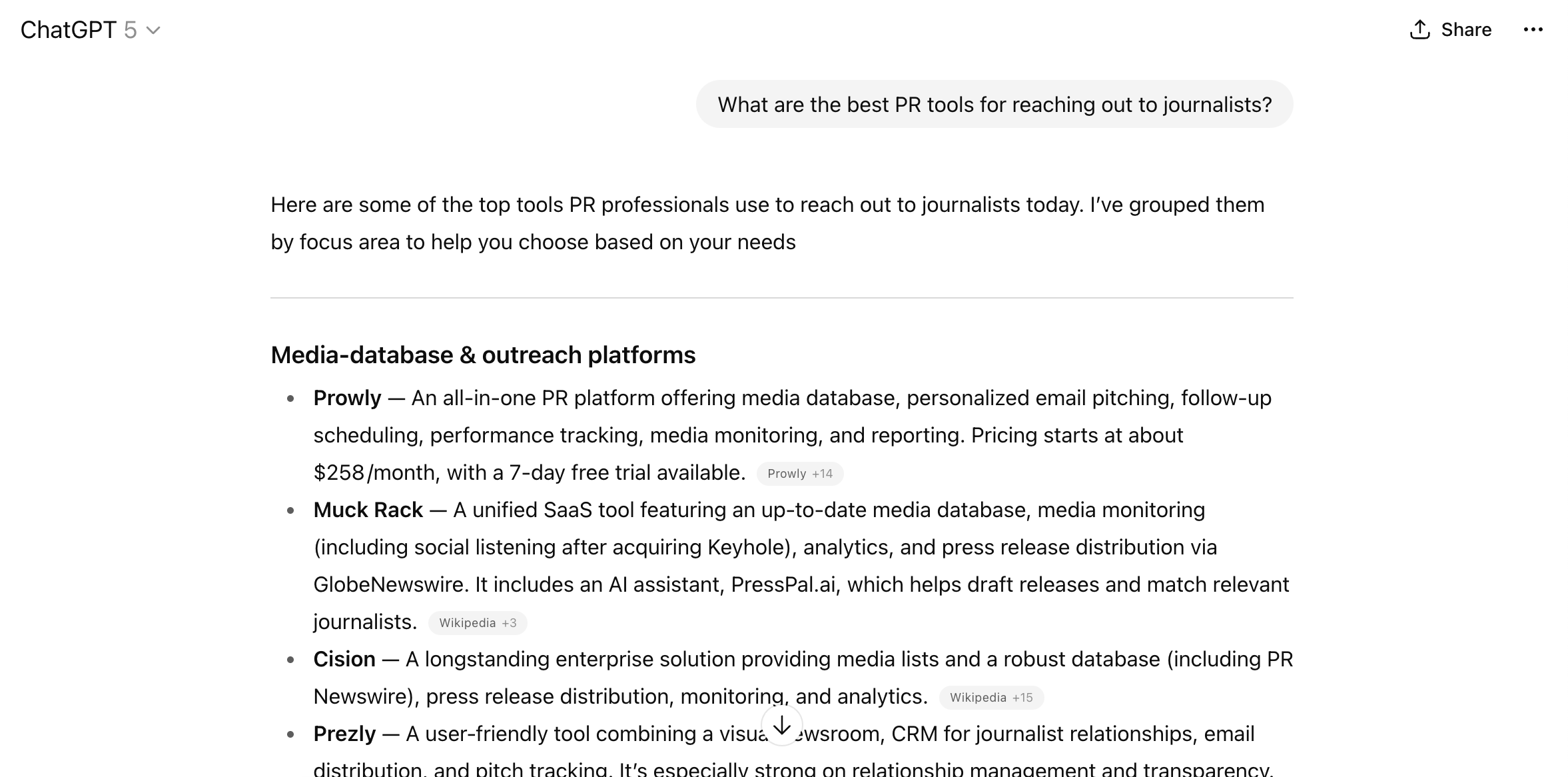
For example, you can create a large body of content around customer feedback tools. Then, once someone asks an AI engine about the best customer feedback tools today, those engines pull from your data and recommend you as a solution.
💡 The main purpose of LLM seeding is to get your brand mentioned in the right context, so you can get high-quality leads from AI models.
LLM seeding is important because AI models pull LLM citations from trusted, visible, and structured sources. And while some part of LLM seeding success depends on external factors (e.g., winning PR coverage), there are certain things you can do to come up in AI search results.
Where LLMs get their data
The first part of LLM visibility is figuring out where large language models get their data. With each month, we get new insights into LLM data sources. You can also gain quite a lot of insight if you simply ask a tool, such as ChatGPT, how it pulled a certain answer.
#1 Pre-trained general web data
The first source for LLMs is their pre-trained general web data. In other words, large language models scrape the web to form something called a Common Crawl with a certain cutoff date. In the C4 Common Crawl, for example, there was 750GB of web text.
This includes data from high-authority and niche publications, as well as general pages on different websites.
All of this data is pulled from the web, hence why many experts claim that SEO and GEO are in fact very similar.
#2 Wikipedia
The second most quoted resource is Wikipedia. For example, Wikipedia accounted for 3% of the total data pulls in GPT-3. As an independent and heavily moderated data source, LLMs trust Wikipedia over third-party websites. However, large language models also consider some vendor websites.
Although highly relevant, these numbers are historic and newer models like GPT-4o, Claude 3.5, and Gemini now rely much more on licensed sources, curated datasets, and refined retrieval methods.
#3 Reddit, Quora, Stack Overflow
Q&A sites such as Reddit, Quora, and Stack Overflow contain real-world FAQ style content that LLMs love to use and reference. For GPT-3, for example, Reddit was referenced in 22% of training outputs. LLMs also tap into niche forums to get highly relevant, unique insights on specific topics.
In fact, OpenAI famously struck a deal with Reddit to use its content as training data in May 2024. This is about the same time they made a partnership deal with Stack Overflow.
#4 Review websites
Keeping in line with that same theme, AI systems look at independent review websites, such as Capterra, G2, TrustPilot, and others. They heavily rely on user reviews to recommend certain products and services.
#5 Licensed news partners
Lastly, there are licensed news partners for large language models, such as Reuters and Bloomberg. Although exact details are often undisclosed, these datasets provide more structured, higher-quality product information for recommendations.
In general, as a business or organization, you can influence the vast majority of these sources through the process of LLM seeding. One of the ways to do that is through public relations.
PR channels that seed LLMs
If you run a PR team and you want to know which areas to focus on to get more LLM presence, there are some clear favorites already. These are the best channels to prioritize in 2025:
Media coverage in authoritative outlets: Articles published by established media outlets carry more weight and are often referenced in LLM training and retrieval. Securing coverage here increases the chance your messaging will surface in AI answers.
Data-backed press releases in public newsrooms: Publishing press releases with supporting data in structured HTML formats makes them easier for search engines and LLMs to parse. Public newsrooms act as a durable source that can be cited long after initial distribution.
Thought leadership on LinkedIn and industry blogs: Posts that provide analysis, unique insights, or expert commentary tend to be indexed widely. When these appear consistently under your brand, they can influence how LLMs describe your company or sector.
Credible vendor comparison or ranking pages: Neutral, fact-based comparisons or rankings are heavily reused in AI outputs. Objective pages that prioritize clarity over sales copy have a higher chance of being picked up.
Event and award listings on reputable sites: Recognition from well-known events or award platforms adds authority. These pages often get referenced by LLMs as background context when highlighting company achievements.
Crafting PR content that models will use
Standing out in LLMs boils down to two things:
- Providing useful information
- Structuring that information in a way that is easy for the LLM to understand
This is how you can create content that LLMs will love and fetch from.
- Write clear, standalone definitions: LLMs prefer short, self-contained explanations they can lift directly into replies. Place definitions early in the text and restate them in different sections.
- Use clear attribution: When citing experts or sources, include the full name, title, and organization. This gives credibility and increases the chance that LLMs reference the statement.
- Focus on evergreen, factual statements: Write content that remains valid over time, such as definitions, processes, or universal comparisons. Avoid temporary phrasing like “this year’s update” without context.
- Maintain consistency across sources: Repeat key facts, numbers, and definitions in multiple articles or assets. LLMs rely on frequency and consistency to reinforce accuracy when pulling data.
- Add FAQ or Q&A sections: Include direct questions like “What is X?” or “How much does X cost?” with concise answers of 2–5 sentences. These are often reused by models in responses.
- Use descriptive headings: Break content into short sections with H2/H3 titles that describe exactly what follows, such as “Pricing plans for Freshsales CRM.” This creates natural chunks for AI retrieval.
- Rely on lists and tables: Present features, pros and cons, and pricing in bullet points or tables. Models frequently pull these formats into their answers.
- Repeat key facts in multiple places: Important details like pricing, target users, or main features should appear in the intro, body, and summary so they are not missed in partial extractions.
- Maintain a neutral, factual tone: Avoid sales-heavy language. State facts clearly, for example “Pricing starts at $29/month with a free trial” instead of “Affordable plans designed to scale.”
- Include structured comparisons: Add sections like “Tool A vs Tool B: Which should you choose?” and summarize differences in a few sentences. LLMs often use these in direct comparison answers.
- Keep formatting structured and consistent: Use short paragraphs, bold key phrases, and schema markup where possible (FAQ, HowTo, Product). This improves both human readability and LLM extraction.
Structuring your content in this way not only ensures maximum LLM pickup but is also great for SEO.
Distributing for LLM pickup
LLMs have certain patterns for making sure a brand appears in their search results. Some outlets get a lot of coverage while others are ignored, and it all depends on your target audience and the way they interact with large language models.
In other words, you have to find out which LLMs favor which sources. There are tools that can do this in 2025, but they come with big price tags. Luckily, you can do a big portion of the work yourself.
- Start with a large language model or a tool (e.g., Claude)
- Ask Claude a question about your target market (e.g, What are the best CRMs for startups?)
- Look at the sources provided by the tool
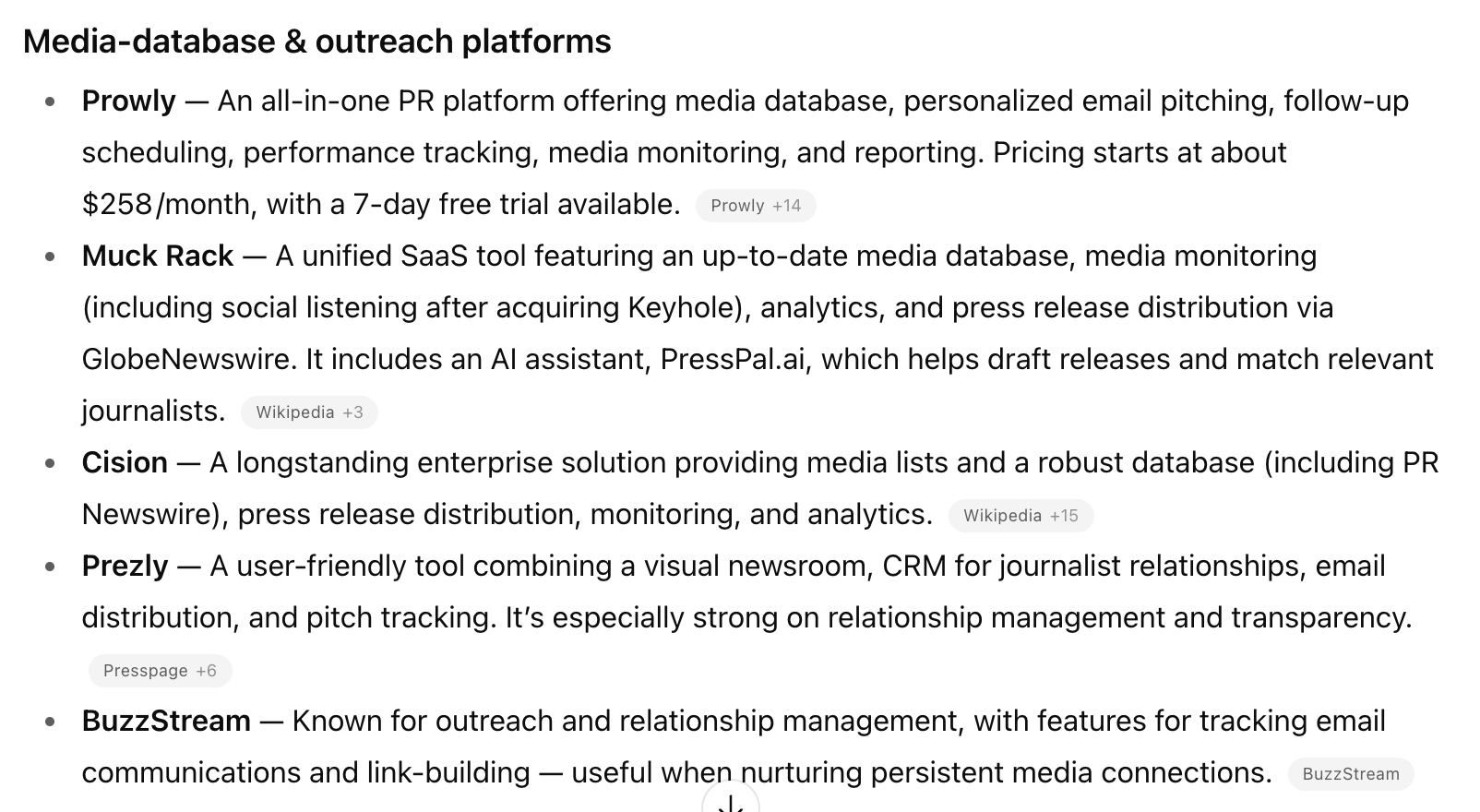
This is not foolproof, but it's an excellent start. Note that all AI tools are built to learn, and as you use them, they learn more about your patterns and background. Simply put: the answer you get will be influenced by your previous interaction with the tool.
If you have asked Claude about the best CRMs before and you happen to work at HubSpot, it's going to favor HubSpot as a result.
For this reason, it's important to mix and match how you ask LLMs about information. You could try asking:
- In incognito mode
- From a different account
- From a mobile device
This will give you a variety of sources to compare against. You might also want to ask your friends/coworkers/customers to ask the same questions about a specific product or category from different locations around the world.
Eventually, you'll start seeing a pattern, and you can make a conclusion on where LLMs pull data from. For one client, for example, despite their strong online presence, their biggest impact came from having their brand mentioned in a Wikipedia article.
For your clients, the most significant data sources for LLMs could be top-tier or niche authority websites in their industry.
Tracking your LLM presence
You can track how AI tools talk about you and your competitors quite easily. As AI tools have spread, so have the tools used to track coverage in AI search results. Platforms such as Brand24 and Profound, among others, let you track brand mentions across ChatGPT, Claude, Perplexity, and other tools.
You can track how many times a certain LLM covered a brand and which sources they used in the process. For example, you can find out that a competitor has been getting plenty of mentions by showing up in Reddit threads and then use that information to build your own SEO, PR, and content strategy.
How Prowly helps PR teams seed LLMs
Earning brand mentions and PR coverage becomes easy if you use the right tool for the job. Prowly has a rich feature set for PR pros and, in light of the AI era, we wanted to make it even more useful with tools that help you get picked up in LLMs.
Some of those AI friendly tools in Prowly include:
AI-ready press release formatting: Prowly makes it simple to structure press releases with clear headings, boilerplate details, and standardized layouts. This format is not only easy for journalists to republish but is also more likely to be indexed and reused by LLMs in future answers.
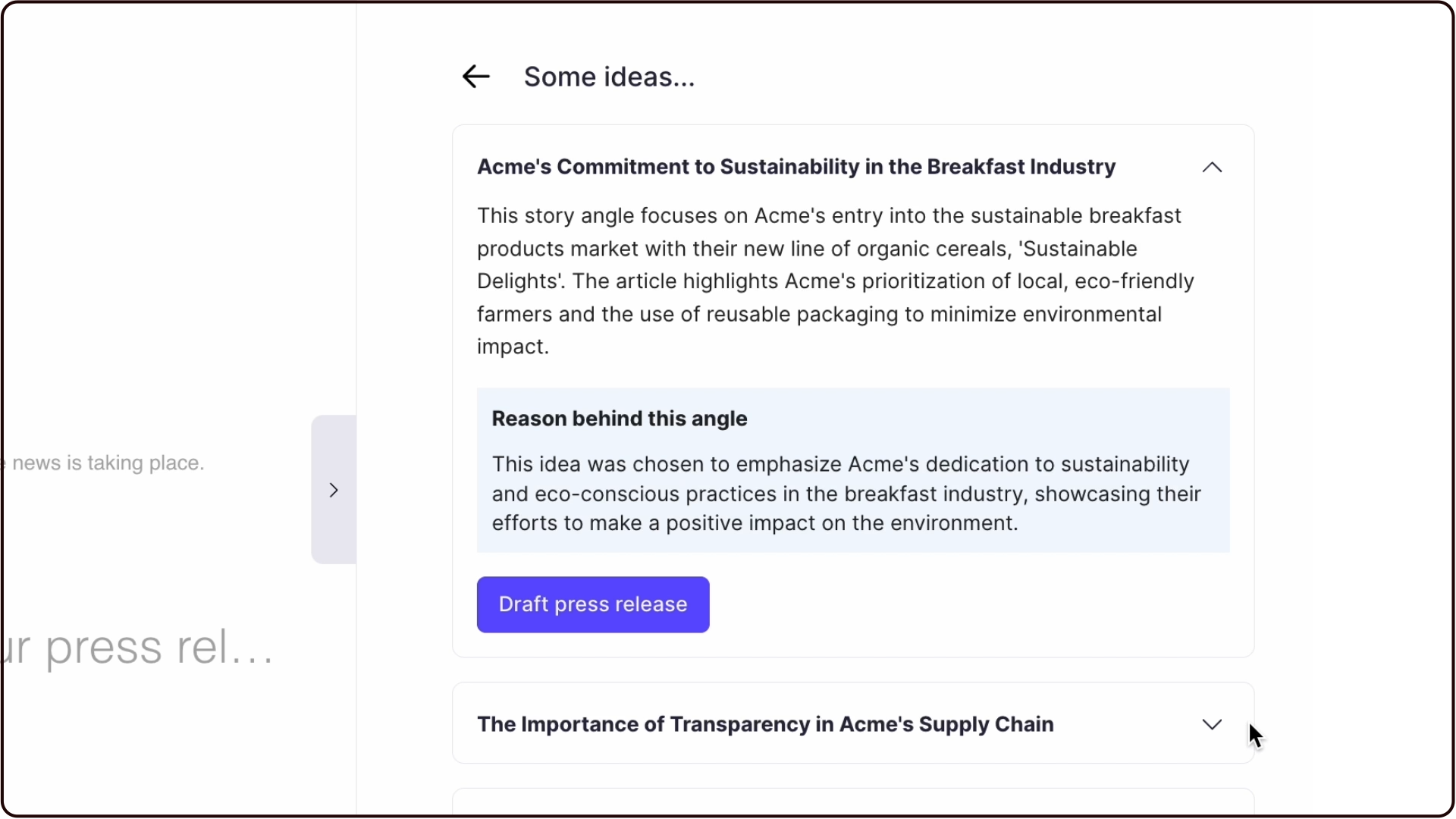
Distribution to trusted media networks: By sending out press releases to established outlets and verified journalist contacts, Prowly ensures that your news is published in credible places. LLMs give higher weight to content that appears across multiple trusted sources.
Monitoring for media and AI mentions in one place: Prowly combines media monitoring with AI-specific tracking, so teams can see where their news shows up in traditional coverage and when it is being referenced by large language models. This gives PR teams the full picture of how their content is being surfaced and reused.
LLM seeding map for PR teams
Not sure which outlets are worth your time? Here is a handy seeding map to help you prioritize time and resources, along with a PR tactic for each approach to drive real results.
| Favored by | Why AI uses it | PR tactic to seed content | |
| High-authority news outlets | ChatGPT, Perplexity, Google AI Overviews, Gemini | Trusted, fact-checked, evergreen reporting | Secure expert commentary & data quotes in top-tier media; use press releases with strong hooks to pitch journalists |
| Licensed news partners | ChatGPT, Perplexity | Paid/licensed content partnerships with LLMs | Target outlets with known licensing deals (Reuters, Bloomberg) via data-heavy press releases & exclusives |
| Niche industry media | Perplexity, Google AI Overviews, Gemini | Domain expertise, depth, relevance | Build relationships with trade journalists; offer thought leadership pieces and unique data |
| Wikipedia & Wikidata | ChatGPT, Perplexity, Gemini | Structured, neutral, reference-style content | Maintain accurate Wikipedia entries for brand, key people, products; ensure citations from reliable sources |
| Vendor & review sites | Perplexity, Google AI Overviews | Comparative, data-driven product coverage | Encourage user reviews on trusted platforms (G2, Capterra, TrustRadius); pitch editors for inclusion in rankings |
| Community Q&A forums | Google AI Overviews, Gemini | Authentic, user-generated context & sentiment | Participate in relevant Reddit/Quora threads; provide authoritative answers with brand attribution where relevant |
| YouTube & video content | Google AI Overviews, Gemini | Highly indexed, visual demonstration content | Publish explainer videos & interviews with experts; optimize descriptions for entity recognition |
| Government & NGO sites (.gov/.org) | ChatGPT, Perplexity | High trust & neutrality | Provide data/research to relevant agencies; partner on reports or initiatives that get published on official sites |
| LinkedIn posts & articles | Google AI Overviews, Gemini | Professional thought leadership source | Post authoritative industry insights under verified personal & company profiles |
| Event & award listings | Google AI Overviews, Gemini | Proof of credibility & relevance | Get listed in industry award sites, conference speaker lists, and official exhibitor pages |
Get featured in AI search responses today
Standing out in LLMs takes more than creating great content and pitching journalists with the same old tactics. To get tangible results, you need to understand how LLMs access information and which sources they favor or disregard. And perhaps most importantly, you need to use the right tools for the job.
With Prowly, you get all the tools to make sure your press releases reach both journalists and large language models.