
You can’t spell “interesting points of view from the world of PR” without “Prowly #PRChat”! Ok, maybe you can. The point is that this is where we give a forum to voices from all over our industry and get insights, opinions and more from a diverse group of pros on the topics of the day.
Today we’re talking to Brett Farmiloe, founder and CEO of Terkel, a Q&A site that allows PR professionals to answer questions and get insights published in articles. Think of HARO but for PR. Brett has authored pieces for an impressive list of industry publications and general business forums. He is an experienced speaker and presenter as well.
When he’s not eating anything but Hot Pockets for 30 days to bootstrap a startup or helping Hugh Jackman launch a coffee brand (wait, what?), he’s busy at his own digital marketing agency.
Here’s what Brett had to say in response to our questions.
What’s something every PR professional is trying to do that you’ve discovered a better method for?
One of the main objectives PR professionals have is to build visibility for their clients. Traditionally speaking, “the pitch” has been a primary way to achieve that objective.
Personally, I don’t like pitching. I also don’t like receiving emails. So, I created a Q&A site that spares journalists from fielding pitches, and relieves PR professionals from making a pitch.
The end result is journalists get connected to expert insights without all the back and forth that goes on behind the scenes. It feels a little cleaner, produces results, and certainly reduces clutter in the inbox.
What’s a resource/tool/channel PR professionals aren’t using correctly or to its fullest?
Expert insight platforms like Terkel or HARO are excellent ways to secure valuable placements for clients. Unfortunately, the success rates on expert insight platforms can be quite low and can lead to frustration for both PR professionals and clients.
Everyone has expertise in something, but no one is an expert in everything. The temptation with expert insight platforms is to answer all questions in hopes that some success will come of it. But as machine learning and natural language processing becomes more prominent on platforms, not only will answering all questions prevent short-term success, it can also be detrimental to long-term user reputation.
Bottom line: stick to your expertise. By answering questions that speak to your expertise or experience, you’ll be adding value to a story and will experience more success.
What's the story behind creating Terkel? Can it help PR professionals?
Terkel is a Q&A site that connects brands with expert insights. Our big vision is to democratize thought leadership by giving voice to the uncelebrated.
The foundational idea for Terkel dates back to a series of RV roadtrips I took about fifteen years ago. Myself and three friends traveled 16,000 miles across 38 states to interview more than 300 people about their career paths.
The thing that stuck with me from those interviews was that people don’t have many meaningful opportunities to share their life experiences and expertise. Why else would 300 people spend an hour with four college grads to share the most intimate moments and learnings of their life?
People need a meaningful outlet to share, and Terkel provides an accessible platform to do so.
And in terms of helping PR professionals, Terkel is a simple way to answer questions and get clients published in more than 250+ publications.
What’s a recent thing you tried in your company that delivered surprising results?
Running a technology company provides the opportunity to dream up endless experiments with defined hypotheses and expected outcomes.
One experiment I was surprised by was the “Skip” button on Terkel, which allows a person to skip a question that doesn’t speak to their expertise or experience. At some point, we didn’t think the Skip button was important. So, we took it away.
We were wrong. Users requested us to bring it back within the hour, and now the Skip button is clicked more than the Answer button on the Terkel platform.
Do you think storytelling is necessary for PR?
I think the easy answer is “of course.” But I’ll go further and say that for certain types of PR, such as PR via expert insight platforms, storytelling doesn’t matter.
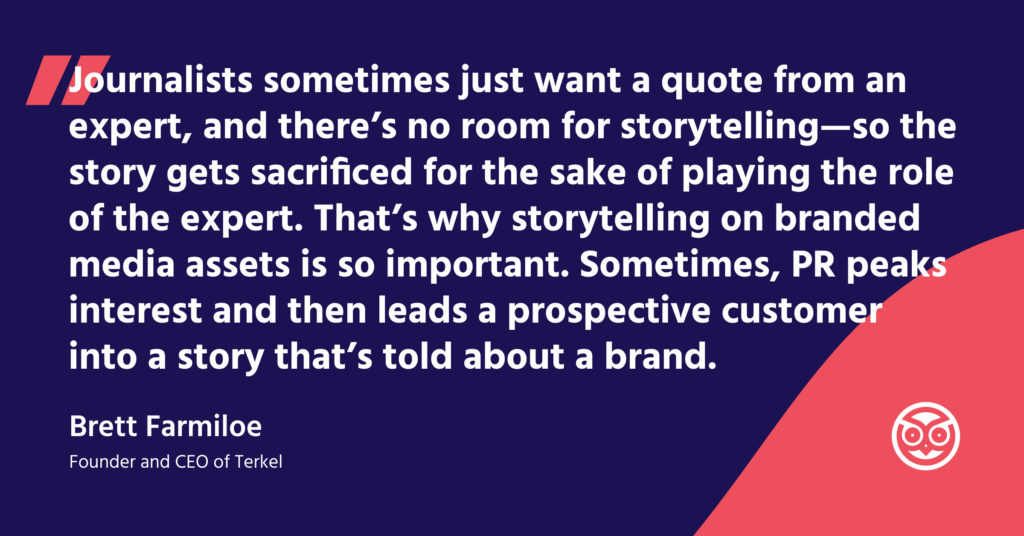
Journalists sometimes just want a quote from an expert, and there’s not room for storytelling. In that scenario, the story gets sacrificed for the sake of playing the role of the expert.
That’s why storytelling on branded media assets like a website or social is so important. Sometimes, PR peaks interest and then leads a prospective customer into a story that’s told about a brand.
How do you go about tracking media coverage and measuring your PR efforts?
We track placements made through Terkel and provide people with a dashboard to view all of their recent placements. People who use Terkel can view their “Success Rate” - calculated by “placements” divided by “questions answered” - which is a true measurement of “efforts.”
Tracking “effort” is actually underrated. PR pros want to know what the return on their time is. All too often, that metric gets lost. We felt it was important to showcase success so people would know where they’re succeeding or falling short.
What should every PR practitioner stop doing?
The stuff that’s not working. Identify an objective, establish metrics around the objective, and focus on the tactics that drive results. Rinse, repeat, and innovate.
What is the most gratifying part of your job?
We did a video shoot recently, where we invited about eight users to come share their experience of using Terkel on camera. Half of the people I had never met, spoken with, or heard of before. Listening to their experiences and hearing about the impact our platform has had on their businesses was pretty gratifying.
Because at the end of the day, whether you’re promoting a client, building a side hustle, or running a company - you just want to see the impact. People need to see the significance of their work. And when they get to see and experience the significant impact…well, that’s a nice feeling.